

Draft in minutes
Typically 1 to 3 minutes per audio hour: an AI draft that's already proofread and formatted, so you start reviewing, not typing.
For digital reporters
I'll draft it. You make the call.
Typically 1 to 3 minutes per audio hour: an AI draft that's already proofread and formatted, so you start reviewing, not typing.
Take on more files each week.


Get hours back
Typically 1 to 3 minutes per audio hour: an AI draft that's already proofread and formatted, so you start reviewing, not typing.
Tracked AI edits you accept or reject.
Labels from your job sheet and fast fixes.
Check crosstalk against the recording.
No reformatting.
Export when you are done.
How it works
Upload audio and job sheet.

In your template.


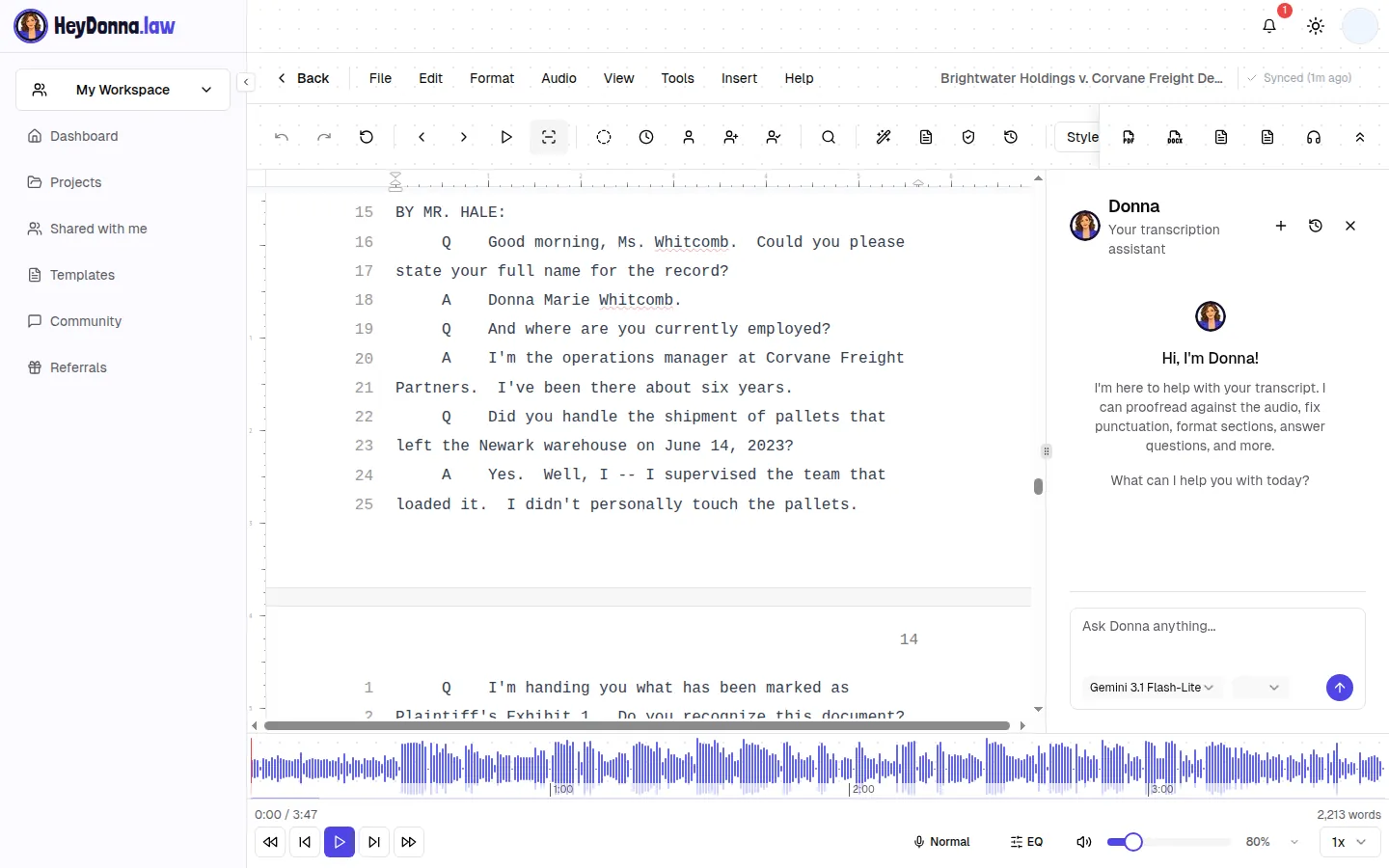
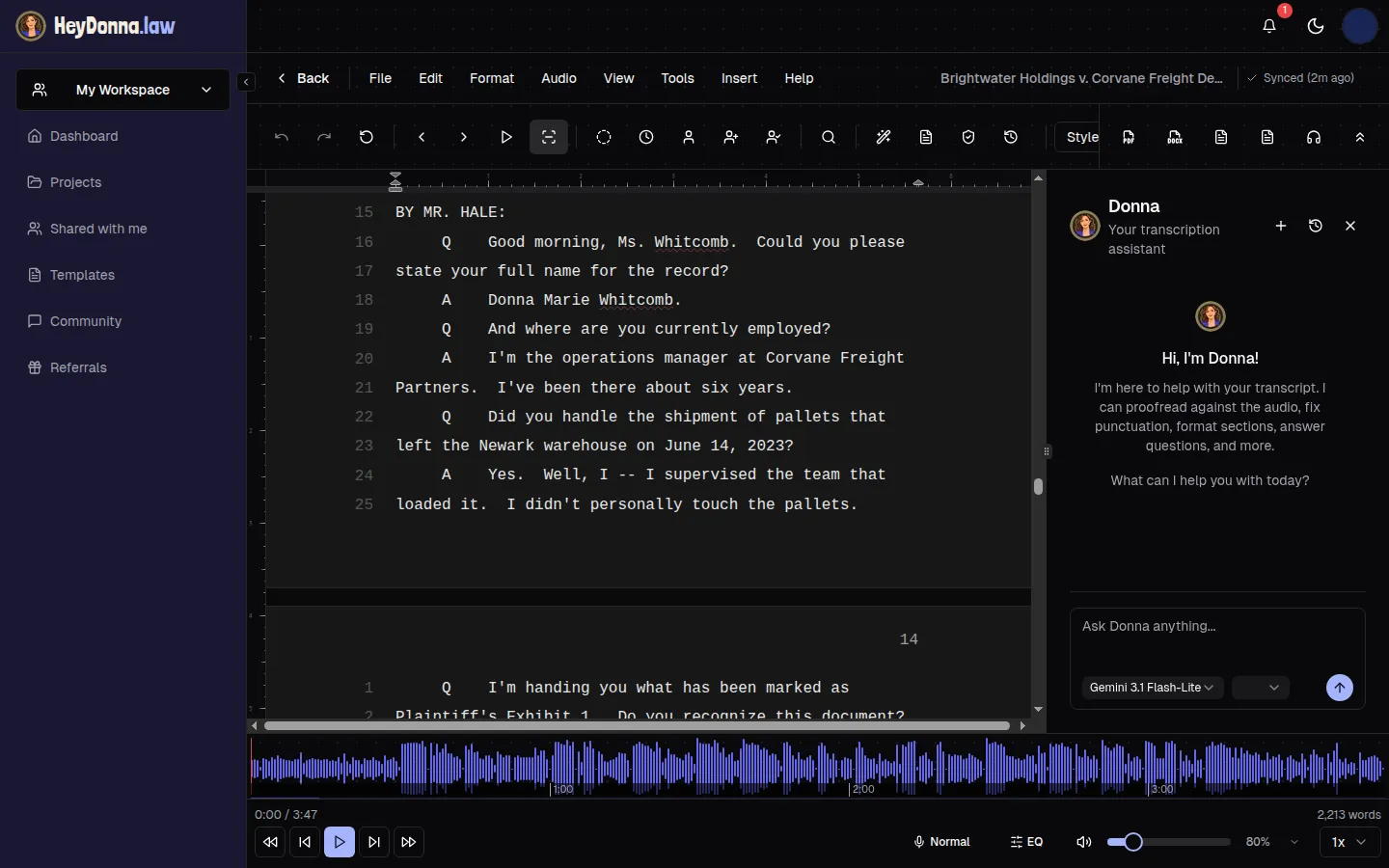
Against synced audio, accept or reject edits, export DOCX.


Pay as you go
1 credit = $0.01. No subscription. Top up only when you need more.
$5
500 credits
$25
2,500 credits
$100
10,000 credits
Sample
Synthetic sample deposition, not a client file.
One run of text. No labels, no punctuation.
please state your full name and your business address for the record thomas eldridge wren t h o m a s e l d r i d g e w r e n my work address is uh nine forty canal street marlow city and what do you do for a living i'm the regional dispatch manager at peregrine freight systems i've been there uh about four and a half years
Q./A. lines, speakers and punctuation.
BY MS. CASTELLAN:
Q.Please state your full name and your business address for the record.
A.Thomas Eldridge Wren. T-H-O-M-A-S. E-L-D-R-I-D-G-E. W-R-E-N. My work address is, uh, nine-forty Canal Street, Marlow City.
Q.And what do you do for a living?
A.I'm the regional dispatch manager at Peregrine Freight Systems. I've been there, uh, about four and a half years.
You stay the reporter
Every edit is tracked.
Why reporters need time back
21%
Fewer stenographers in the US over the last decade, leaving about 23,000.
74%
Drop in enrollment at stenography schools over the same period.
33%
Of US court reporters and simultaneous captioners are self-employed, among about 19,900 jobs in 2025.
AAERT is the association for digital reporters and commissioned its study, so read those figures as an advocate's. BLS projects no change in total jobs from 2025 to 2035. Fewer reporters and flat headcount mean more files per reporter, which is the problem HeyDonna is built for.
From the pilot
A lengthy four-hour file gets formatted in under 5 to 10 minutes, and the results are remarkably accurate. Once I export the DOCX, I barely need to make any additional edits before delivering it to the customer.
HeyDonna puts editing, formatting and proofreading all under one roof. I can proofread the transcript, format sections, swap speakers and run spellcheck without leaving the editor.
HeyDonna has enabled me to finish files much faster than I was able before, increasing my overall workflow. The auto-proofreading and auto-formatting processes have been the greatest help as HeyDonna gives a better and near accurate output than traditional ASR.
Starting with a transcript that is already formatted and proofread … cuts my turnaround time in half. HeyDonna allows me to spend less time editing and more time delivering quality work.
HeyDonna is an AI transcript editor for digital court reporters and legal transcriptionists. It drafts, proofreads and formats a transcript in your template, tracks every edit, and leaves the review and certification to you.
HeyDonna is not CAT software and does not capture live. It exports DOCX, and RTF for court reporting (CAT) software, as the editor menu docs describe. Try an export on a real file first.
Yes.
Template-based export.
1 credit = $0.01. 2,500 free credits, then $5, $25 or $100 packs.
Reject it.
Public beta.