

Earlier this week we put one deposition page side by side in New York, Texas and California. We closed that post with a question: “which state’s format has tripped you up the most?” Today we’re turning it into a poll, with three more formats to vote on.
These three are worth knowing if you transcribe from audio. Federal courts, Florida and Washington all write the transcriber, not just the reporter, into their format rules. Each one also puts the Q and the answer text in a slightly different place.
The short version
| Federal courts | Florida | Washington (appeals) | |
|---|---|---|---|
| Lines per page | 25 lines of text | At least 25, numbered 1 to 25 | 25 lines of type |
| Characters | 10 to the inch, about 63 a line | At least 56 a line on Q and A | Pica or equivalent, no more than 10 to the inch |
| Q and A | At the left margin; text starts on the fifth space | No more than 5 spaces in; no more than 5 spaces from Q or A to the text | 1 space in from the lined margin; testimony at 5 spaces |
| Margin lines | Solid left and right lines required | Not specified | Margins lined 1 3/8 in. left, 5/8 in. right |
| Source | Guide to Judiciary Policy, Vol. 6, Ch. 5, § 520 | Fla. R. Gen. Prac. & Jud. Admin. 2.535(f) | RAP 9.2(f) |
These are summaries. Always read the current text of the rule, then the client’s own style guide. A firm, agency or court manual can be stricter than the rule.
Federal courts: one format, no deviations
The Judicial Conference adopted a uniform transcript format in 1944, and the Guide to Judiciary Policy (Volume 6, Chapter 5, section 520) still sets it out. It is unusually firm. The Guide says no court, judge, supervisor, reporter or transcriber may authorize a deviation, because per-page rates assume the format.
The main rules:
- Lines: 25 lines of text a page. Page numbers and headings don’t count toward the 25.
- Characters: 10 letters to the inch, which the Guide says gives about 63 characters a line.
- Margins: preprinted solid left and right margin lines, with text running from 1 3/4 inches on the left to 3/8 inch from the right edge.
- Q and A: the Q or A starts at the left margin. The text after it starts on the fifth space, and carry-over lines go back to the margin.
- Colloquy: the speaker’s name starts on the tenth space, followed by a colon, and the statement starts on the third space after it.
The same section applies to electronic copies. A PDF or ASCII transcript must still follow the approved page format.
Florida: one format for every court, depositions included
Florida’s Rule of General Practice and Judicial Administration 2.535(f) says transcripts of all judicial proceedings, depositions included, must be uniform in and for all courts throughout the state. The Florida Supreme Court amended the rule on November 7, 2024, effective January 1, 2025.
The main rules:
- Lines: no fewer than 25 printed lines a page, numbered 1 through 25, with no more than a double space between lines.
- Font: 9 or 10 pica, 12-point Courier, or 12-point Times New Roman.
- Characters: no fewer than 56 characters a line on questions and answers, unless the speaker’s text ends short.
- Q and A: each question and answer starts on its own line, no more than 5 spaces from the left margin, with no more than 5 spaces from the Q or A to the text. Carry-over lines go back to the left margin.
- Colloquy: the speaker’s name starts no more than 10 spaces from the margin, and carry-over colloquy is indented no more than 5 spaces.
Note the wording. Federal rules give exact positions, while Florida mostly gives maximums. A Florida page with Q at the margin can still be compliant.
The amendment also dropped the old 200-page limit on volumes. If your checklist still has it, update it.
Washington: the appeal record has its own form
Washington’s Rule of Appellate Procedure 9.2(f) sets the form of the verbatim report of proceedings, the transcript that goes up on appeal. It names “court reporters or authorized transcriptionists” throughout, so it applies to you if you prepare a report from a recording.
The main rules:
- Page: 8 1/2 by 11 inch paper, with margins lined 1 3/8 inches from the left and 5/8 inch from the right.
- Lines and type: 25 lines of type, double spaced (reporter comments single spaced), pica type or equivalent with no more than 10 characters an inch.
- Indents from the lined margin: 1 space for Q and A, 5 spaces for the body of the testimony, 8 for a new paragraph and 10 for quoted authority.
- Labels: the witness name and type of examination at the top or bottom of each page, and events such as recesses in capitals, centered.
- Front matter: each volume opens with a title page and a table of contents.
This rule covers the appellate record, not depositions in general. For a Washington deposition, ask the firm which layout it wants.
Why the indent matters
The words of the testimony are the same in all three formats. But the Q moves from the margin, to “up to five spaces in”, to one space in, and the answer text moves with it.
That shifts where each line wraps, and where the wraps fall decides how many lines the testimony fills. It’s the same effect as a different line count, only smaller, and it is easy to miss until a reviewer sends the page back.
What to ask before page one
- Which rule or manual? Ask for the document itself, not a description of it.
- Exact positions or maximums? Find out whether the client wants the federal-style fixed indents or just something inside Florida-style limits.
- Margin lines: are lined left and right margins required, and where does the text start?
- Characters a line: confirm the font, the pitch and the expected characters a line.
- Sample page: ask for one approved page from a past job, then match your Q, A and colloquy indents to it.
Set the spec once in a HeyDonna template
Fixing indents by hand on every job is where format errors creep in. In HeyDonna you set a client’s spec once, in a template, and formatting applies it to every project that uses that template.
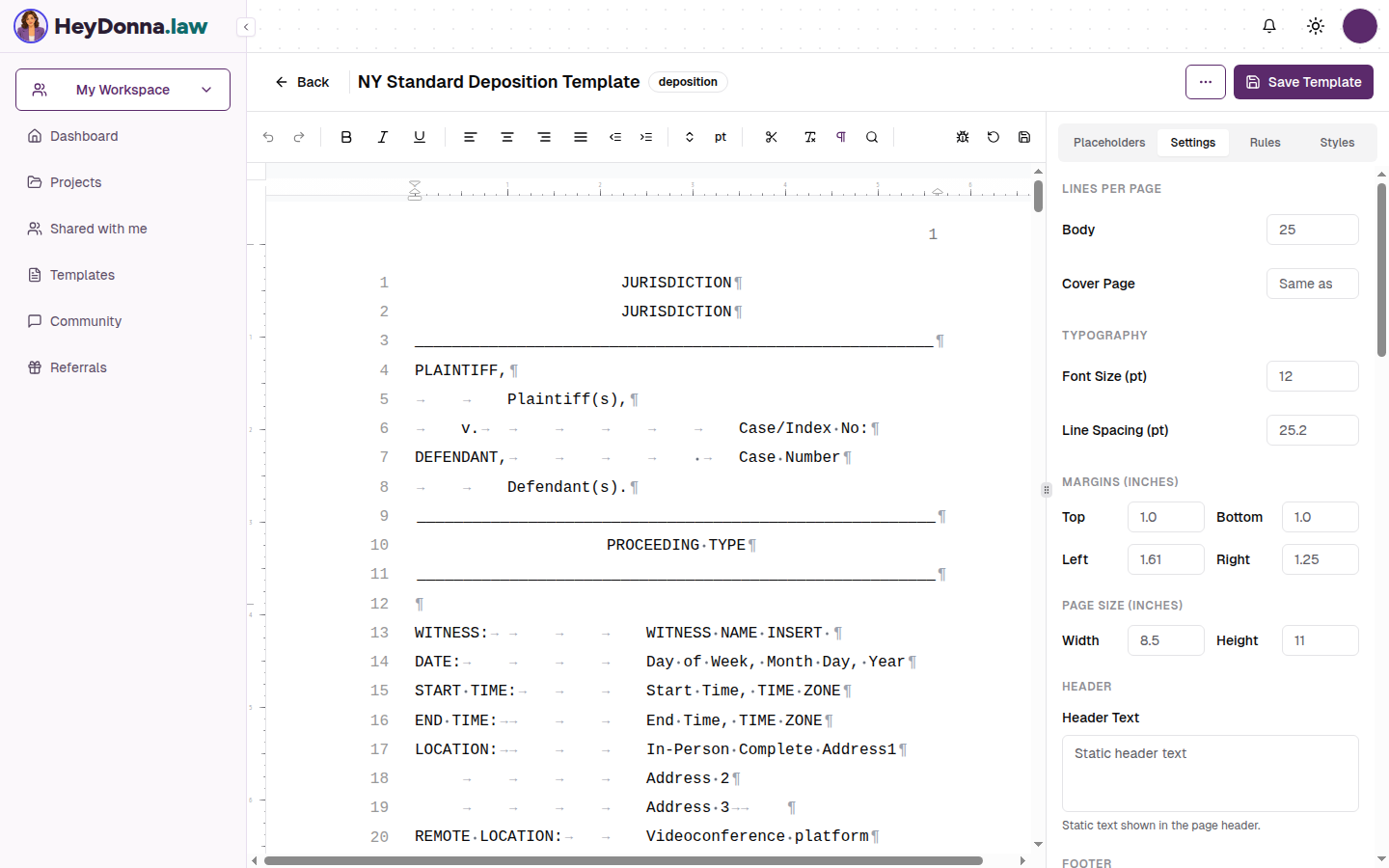
- Page layout (Settings tab): lines per page, font size, line spacing, margins, page size and page borders. When you upload your Word template, HeyDonna detects the margins, line spacing and font size for you to check.
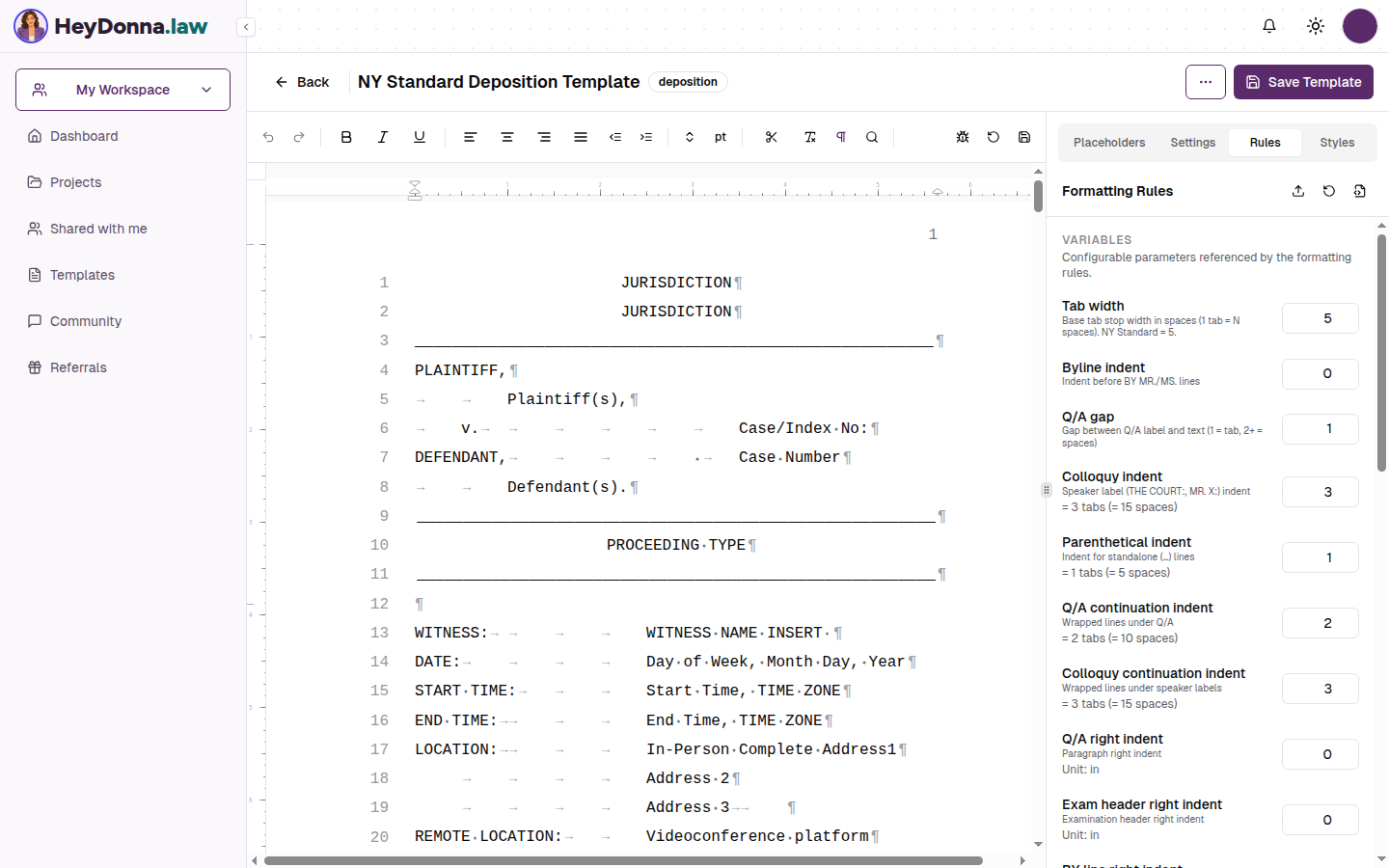
- Formatting rules (Rules tab): the Q and A gap, whether Q and A take a period, and tab stops for speaker labels and continuation text. You can type a change in plain English, such as “indent continuation text by 5 spaces”, and review the rules it generates before saving.
Auto-Process on a Legal project uses that template to format the draft. When you run AI formatting in the editor, Donna uses the same rules and shows the result as track changes for you to review. Keep one template per client or format, for example a federal one and a Florida one. Then check the first formatted page against the client’s sample page, as above. We walked through building a template in How to create a transcript template.
Vote: which format trips you up most?
We’re running the poll today on LinkedIn and X. Pick the one that has cost you the most rework, or tell us which state we should compare next.
Sources: Guide to Judiciary Policy, Vol. 6, Ch. 5, § 520 Transcript Format (via the District of Montana); In re Amendments to Florida Rule of General Practice and Judicial Administration 2.535, No. SC2023-1170 (Fla. Nov. 7, 2024); Washington RAP 9.2.
Related: Same deposition, three states: transcript format by state, How to format a New York transcript: 25 lines a page.