

“Is it 25 lines for New York?” is the kind of question that comes up whenever a reporter or scopist builds a template for a new client. Format specs differ by court and state, and the cost of guessing wrong is a reformatted file. Here is what New York’s court rules actually say, what they do not say, and a checklist for setting up a page in Word.
What Part 108 says
New York’s Chief Administrator’s rules include Part 108, “Format of Court Transcripts and Rates of Payment Therefor.” Section 108.3 sets the standard specifications. The points that matter for page setup:
- Paper: 8 1/2 x 11 inches.
- Lines: each page has 25 numbered lines of material, “excluding a line devoted to the title and page number.”
- Exceptions: the page with the title (or the last of several title pages), the page with the index (or the last of several), and the last page of each day’s transcription.
- Type: 10 type characters per inch.
- Margins: left margin indented 1 3/4 inches, right margin 3/8 inch, with rules marking each. The writing block is 6 5/16 inches wide and 9 inches tall.
- Q and A: the first line of each question and answer is indented five spaces and starts with “Q” or “A”; the text starts at ten spaces; later lines return to the left margin.
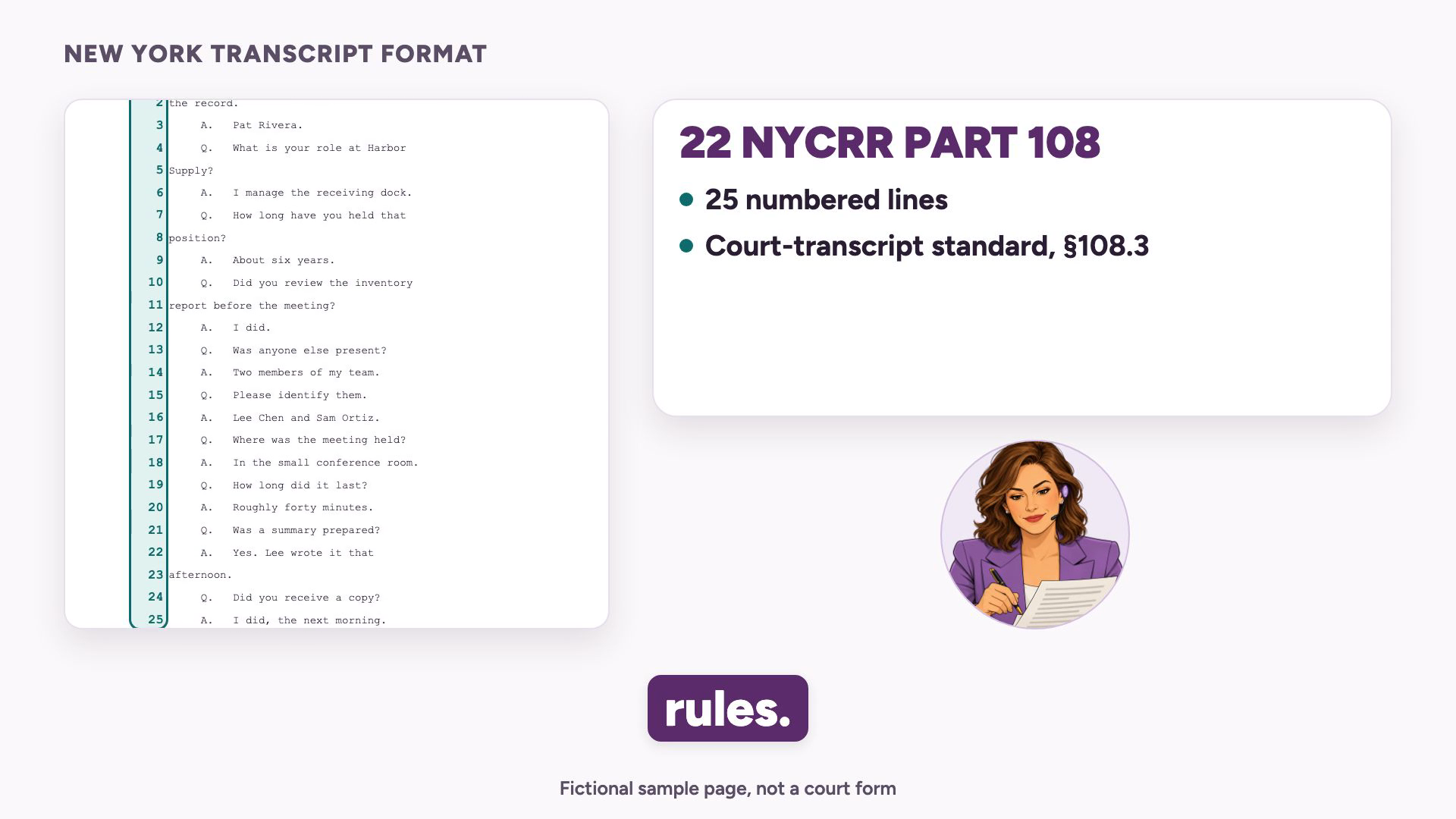 A fictional sample page. The numbered gutter runs 1 to 25 on every full page.
What it does not say about depositions
Plainly: the 25-line rule in 22 NYCRR 108.3 covers court-proceeding transcripts, not depositions.
Part 108 defines a “transcript” as a transcription of the stenographic minutes of court proceedings. That is the scope of the rule. I could not find a New York rule that sets lines per page for a deposition transcript, so I will not tell you one exists. For depositions, the agency or firm style guide usually settles it. If you do not have one, ask for it before you build the template.
Your own template can also differ from Part 108 and still be right for its client. Our sample NY deposition template sets its left margin at about 1.6 inches and its right margin at 1.25 inches, not 1 3/4 and 3/8. That is a reminder that the rule text and a client’s format are two different things.
A Word setup checklist
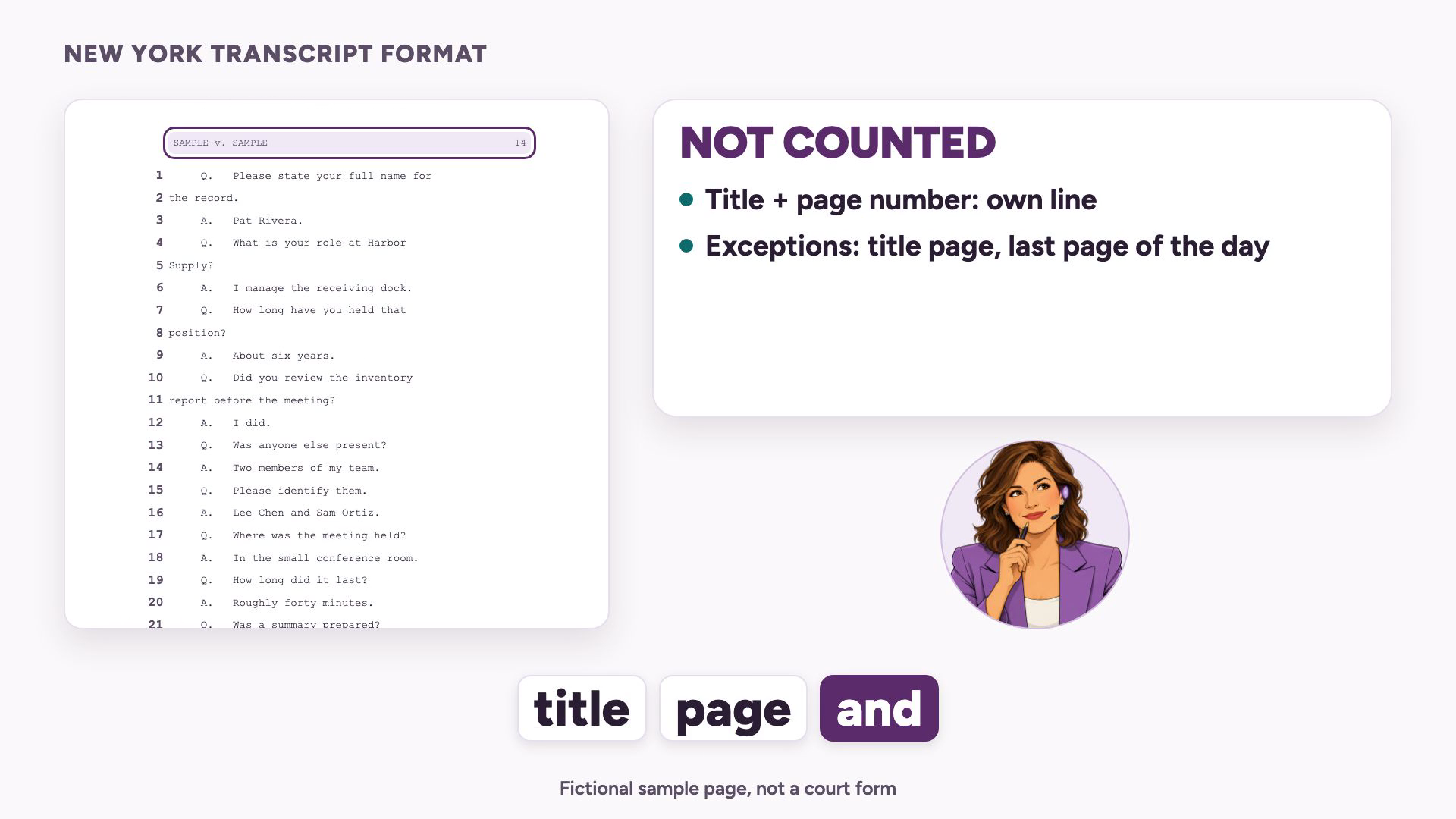 The title and page number sit on their own line above line 1.
- Page size. Letter, 8.5 x 11 inches.
- Font. Courier New, 12 point. At 12 point, Courier New sets 10 characters to the inch, which matches the 10-type rule.
- Line spacing. Paragraph spacing set to Exactly 25.2 pt, with no space before or after. Twenty-five lines at 25.2 pt come to 630 pt, or 8.75 inches. Our sample template uses that pitch.
- Margins. Top and bottom margins must leave at least 8.75 inches of text height on an 11-inch page, so the sum cannot exceed 2.25 inches. The sample template uses 1 inch on top and 1.15 inches on the bottom.
- Line numbers 1 to 25. The quick route is Layout, Line Numbers, Restart Each Page. The alternative is a fixed gutter: 25 labels in a header text box at the same 25.2 pt pitch, so 1 to 25 print on every page whatever the page holds. Pick one and check it on a full page.
- Title and page number. Put them in the header, on their own line above line 1, so they never take one of the 25.
- Q and A indents. If the client wants Part 108 style: Q or A at five spaces, text at ten. At 10 characters per inch, that is half an inch and one inch.
- Exception pages. Plan the title page, index and last page of the day so they are allowed to run short.
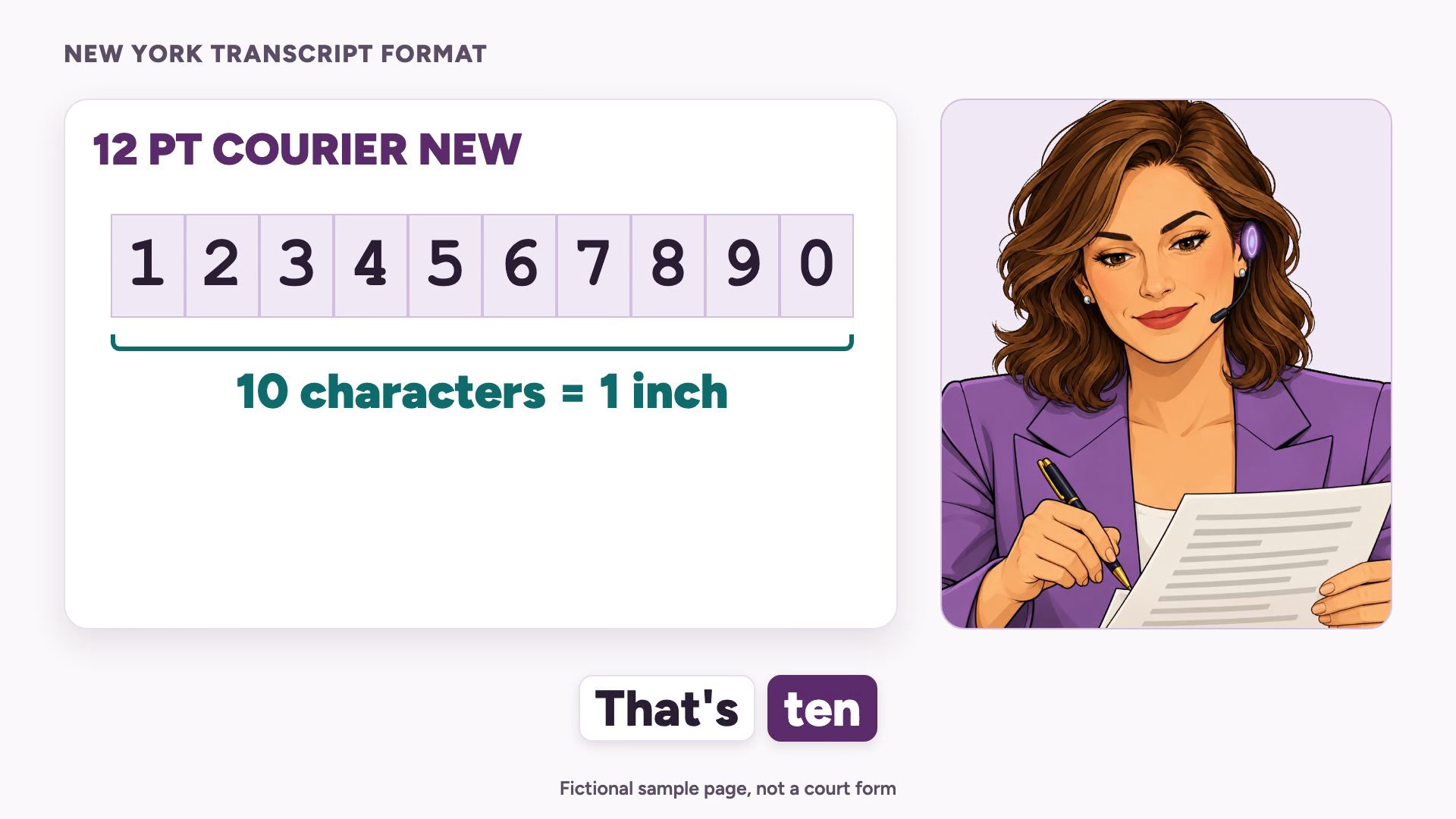 Twelve point Courier New: ten characters across one inch.
Check before you certify
Print or preview a full page and confirm that line 25 is the last line, that no line is split across a page break, and that the numbers line up with the text. A page that holds 24 lines or 26 is a format error, and it is much cheaper to catch it in the template than in the final.
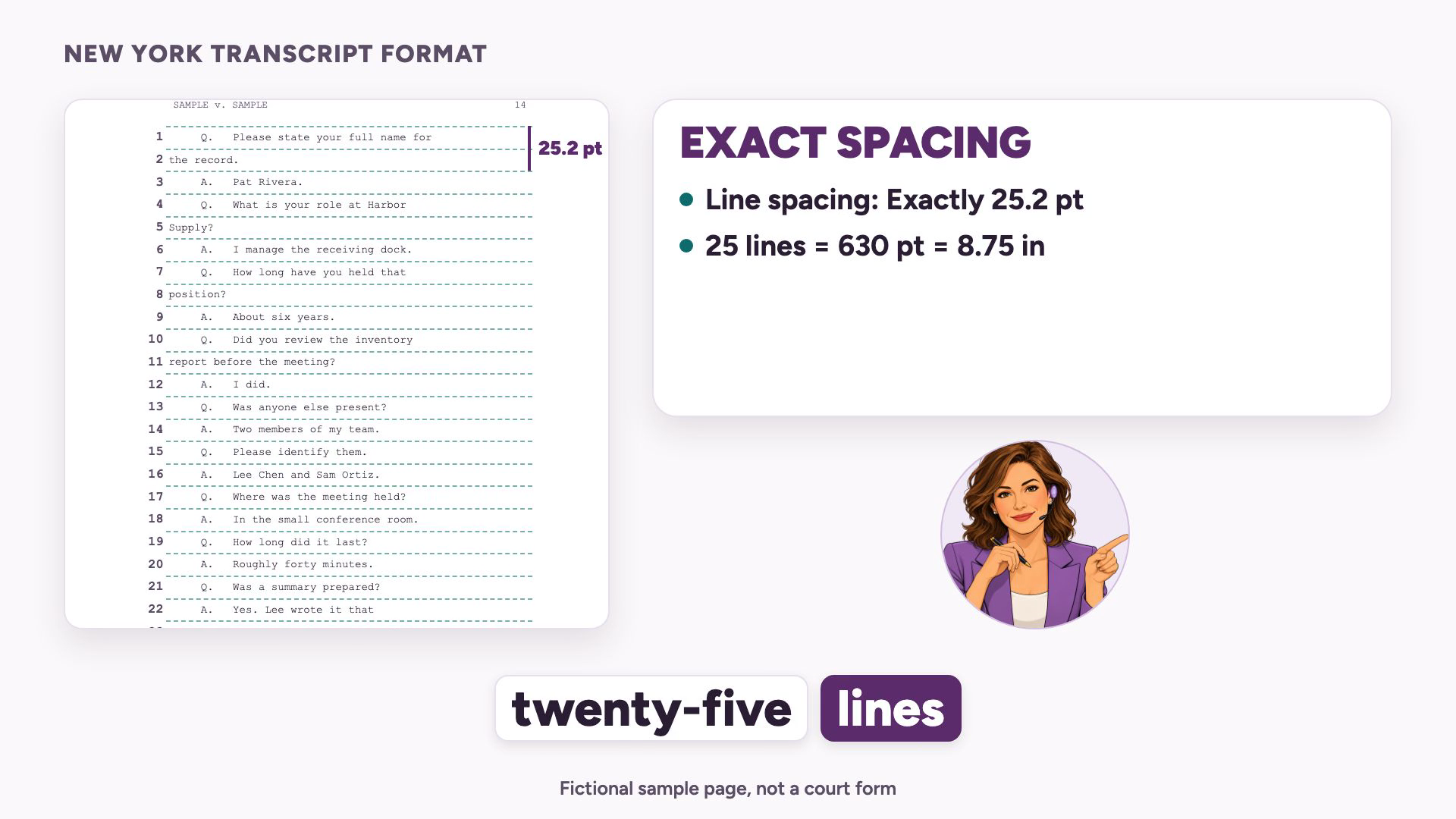 Exact spacing keeps every line on the same grid.
Which format question costs you the most time when you start with a new client: line counts, margins or the Q and A indents?
Sources: 22 NYCRR Part 108, sections 108.1 and 108.3. I checked the text against an archived copy; the live court site blocks automated access.
Related: Same deposition, three states: transcript format by state, How to create a transcript template, Meet Donna, HeyDonna public beta.