

“Which format does this client want?” is a question every digital reporter, scopist and legal transcriptionist asks sooner or later. It usually comes up when the work crosses a state line.
The words of the testimony don’t change. The page does. So does every page and line cite that an attorney will later put in a motion.
This post compares three states side by side. It covers what each one says about lines, characters and the page, what it doesn’t say, and what to ask before you format.
The short version
| New York | Texas | California | |
|---|---|---|---|
| Lines per page | 25 numbered lines | 25 lines, numbered 1 to 25 | At least 25 (state minimum); the LA Superior Court manual uses 28 |
| Characters per line | 10 characters to the inch | 56 to 63, or at least 6.5 inches between margins; pitch 9 or 10 | At least 56 |
| Format box | Not required | Required (solid lines on all four sides) | Not in the state minimum |
| Source | 22 NYCRR Part 108 | Uniform Format Manual for Texas Reporters’ Records | 16 CCR 2473; local court manuals |
The sections below explain each column. Always check the current text of the rule and the client’s own style guide. Local rules and firm preferences can override these defaults.
New York: 25 lines under Part 108
Section 108.3 of New York’s court rules sets 25 numbered lines a page on 8 1/2 by 11 inch paper. The line holding the title and page number doesn’t count toward the 25.
Part 108 is written for court proceedings. We couldn’t find a New York rule that sets a separate deposition layout, so for a deposition the agency’s or firm’s style guide is the real spec. We wrote up the full New York page setup in How to format a New York transcript: 25 lines a page.
Texas: 25 lines inside a box
The Uniform Format Manual for Texas Reporters’ Records applies to both official and freelance reporters’ records, so it covers depositions.
The manual sets these rules:
- Lines: 25 lines of text, numbered 1 through 25 and double spaced. Page numbers, headers and footers don’t count (section 2.13).
- Characters: a pitch of 9 or 10 characters per inch (section 2.3), and 56 to 63 characters per line, or at least 6 1/2 inches between the margin lines (section 2.5).
- Format box: solid top, bottom, left and right marginal lines around the text (section 2.6). Line numbers sit to the left of the box.
The format box is the detail people new to Texas work most often miss.
California: a minimum, then the court’s own manual
California’s minimum transcript format standards (16 CCR 2473) require no fewer than 25 typed lines a page and at least 56 characters on a full line. They also set limits on indents for Q/A, colloquy and quoted material.
The California Court Reporters Association notes an exception. A reporter employed by a court follows that court’s format if it has one. The Los Angeles Superior Court’s Master Format Manual lists 28 lines a page, which is why you’ll hear “California is 28” even though the state minimum is 25.
For depositions, the CCRA’s guidance is to use the California standards unless the venue jurisdiction has its own.
Why it matters: the cite moves
Put the same answer on three different page grids and it gets three different page:line cites. A 25-line page and a 28-line page drift apart within a few pages. A narrower line wraps more often, which pushes text down.
If you reformat after the attorney has started citing a rough draft, every one of those cites is wrong. So settle the format before the first page goes out, not after.
What to ask a new client first
- Which spec? The court’s manual, the state minimum, or the agency’s or firm’s own guide. Ask for the document, not a description.
- Lines and characters: confirm the line count, characters per line and font pitch.
- The box and the gutter: is a format box required? Where do line numbers sit?
- Indents: where do Q and A, colloquy and quotes start?
- Sample page: ask for one approved page from a past job and match it.
Where to check it in your editor
Whatever tool you use, find where it stores the page setup, and check it against the client’s spec before you start.
In HeyDonna, the page setup lives in the transcript template. The screenshots below use a fictional sample deposition.
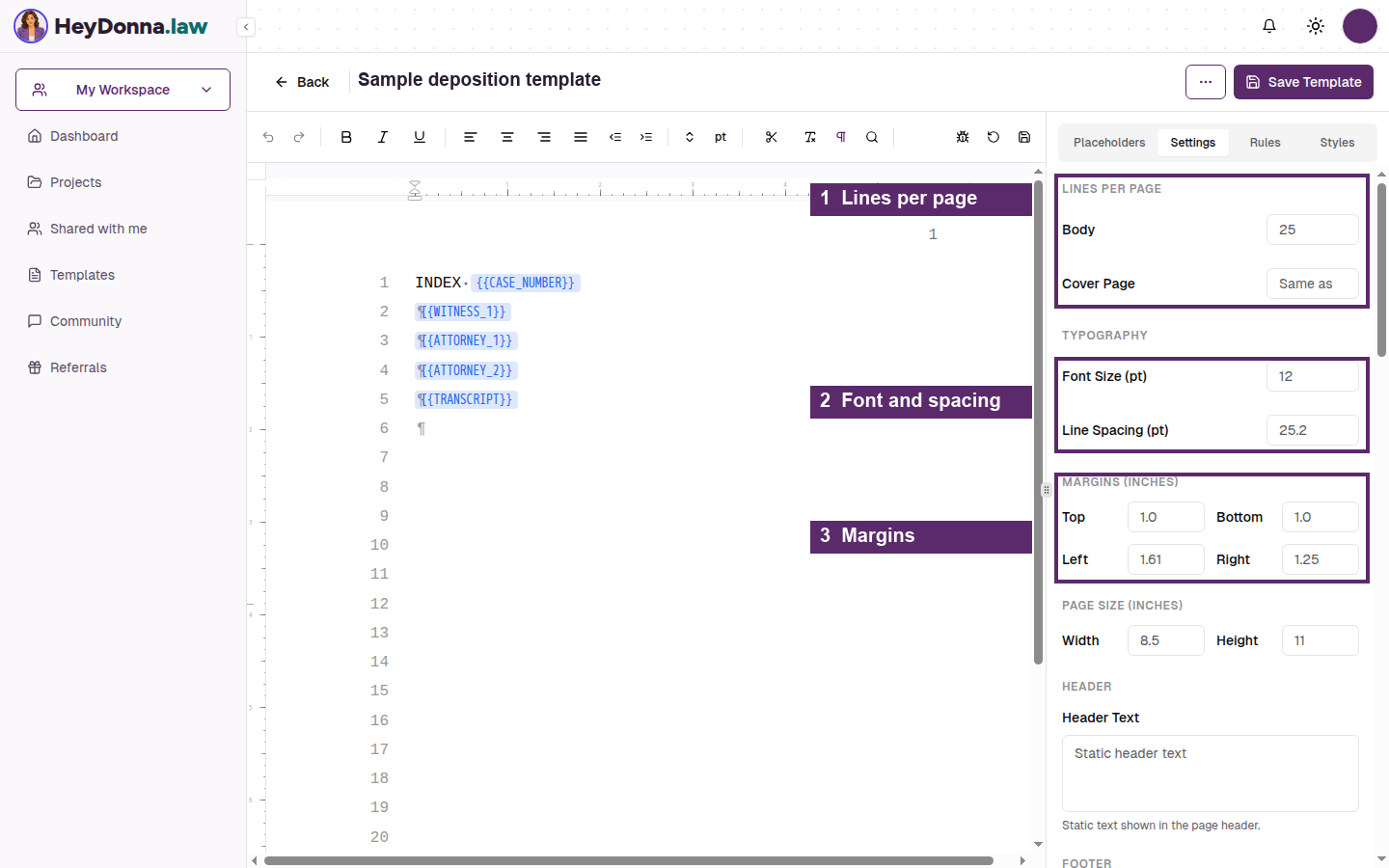 Step 1: The template’s settings hold the page layout, including lines per page.
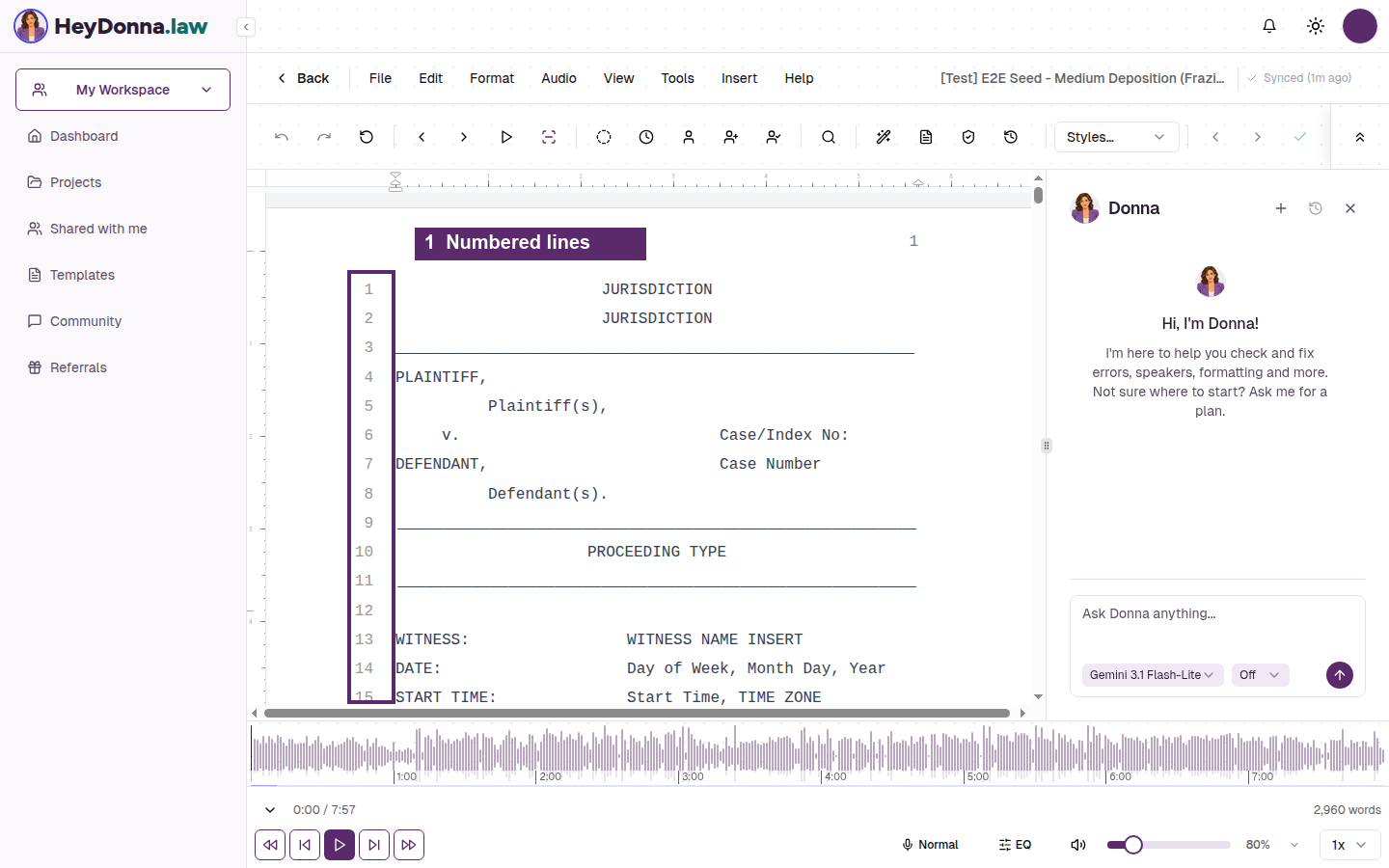 Step 2: Check the numbered lines on a full page against the client’s sample.
One question for you
Which state’s format has tripped you up the most on a new client?
Sources: 22 NYCRR Part 108; Uniform Format Manual for Texas Reporters’ Records; California minimum transcript format standards (CCRA); California Court Reporters Board, 16 CCR 2473; LA Superior Court Master Format Manual.
Related: Federal, Florida, Washington: transcript format compared, How to format a New York transcript: 25 lines a page, How to create a transcript template.